


Santiago
Die Liste enthält 2 Einträge. Suchergebnisse löschen und Gesamtbestand anzeigen.
| Abbildung |
Beschreibung Gesamte Buchaufnahme |
Preis EUR |
|
|---|---|---|---|
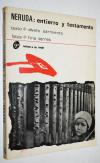 |
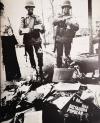
Torres – Sarmiento, Alvaro. Neruda. Entierro y testamento. Fotos: Fina Torres. Las Palmas de Gran Canaria, Inventarios Provisionales 1973. 8°. 151 S. mit 48 Duotone-Tafeln. Illustr. Orig.-Kartonumschlag. (Serie Letras a su himán, 14).
Fernadez, The Latin American Photobook 102. – Rare first edition. – „In September 1973, Fina Torres, a photojournalist active in Venezuela at the time, was in Santiago during the coup that overthrew the government of the Unidad Popular. She photographed the damage done by the artillery to the facade of the Palacio de la Moneda, the armed soldiers in the streets, and other unsettling scenes of everyday life at the time: the cleaning of painted slogans from the walls, people lining up to buy food, the surveillance of the embassies, and the anguished seriousness of people waiting outside the morgue. Photographs of similar scenes can be found in the photobook Chili September 1973 by Koen Wessing, one of whose images is virtually identical to another taken by Torres. Both photographed a darkhaired girl standing at the door of the morgue and showing the ID photo of a soldier. Torres decided to repeat the image to show more clearly the features of the young man who had disappeared, and Wessing did the same. Ten days after the coup, the poet Pablo Neruda died in a clinic in Santiago. Torres photographed the funeral procession, which also laid to rest the Unidad Popular and a whole era of leftist aspirations. The procession turned into a demonstration, in spite of the menacing presence of numerous armed soldiers. … Fina Torres left another testimony, that of the vigil held around the dead body of Neruda. As she recalls, she was „the only photographer in the writter ’s residence on the day of his death.“ The house had been entered and sacked by soldiers, an event almost prophesied in the lines „Traitor / generals: / behold my dead house“ from España en el Corazon (Spain in the Heart). The photos show empty shelves, ashes from the auto-da-fé, open closets, flooded rooms, and other signs of plunder and destruction-images of the desolation that the deceased poet’s relatives, also captured by Torres’s camera, seem not to notice“ (H. Fernández). – Back cover with a vertical tear, otherwise in good condition. Schlagwörter: Chile, Neruda, Pablo, Revolution, Santiago |
200,-- |  |
 |
Wessing, Koen. Chili september 1973. Amsterdam, De Bezige Bij 1973. 4° (24,5 x 20 cm.). [48] p. with 24 Duotone plates, most of which are double-sheet size. Original cardboard cover.
Auer 562. Gierstberg/Suermondt 124 f. Heiting, Dutch photo publications 498. Parr/Badger I, 22. Vgl. Fernández, The Latin American Photobook 102 (Torres, Neruda: entierro y testamento. Las Palmas 1973). – „The book begins with a double-page spread of a pile of burning papers. On the top a face can be glimpsed President Salvador Allende of Chile, overthrown by military revolt. Allende had been democratically elected, but the United States, in one of the most disreputable episodes in its recent history, deemed his socialist government a Marxist threat to American interests in South America. The CIA actively worked to destabilize the country and supported the military junta of General Augusto Pinochet, who seized power in September 1973. The far-from-bloodless coup leaves today’s Chile still trying to come to terms with the damage done to its democratic institutions over three decades ago. The Dutch photographer Koen Wessing was on the streets of Santiago immediately after the coup happened. His gritty documentary pictures were quickly published in this no-frills, extremely elegant photobook by De Bezige Bij, publisher of so many of the best Dutch photographic books. There are not many images in the book, but each is carefully considered, modest and succinct, spread across a double page in graphic gravure. Despite the difficulties of taking photographs in such a tense and difficult situation, Wessing never forgets the value of composition and lighting control. The main thrust of the book is the coup’s immediate aftermath, the shock and grief of the people, the rounding up of Allende’s supporters (or suspected supporters) by the army, and their herding into the now notorious National Stadium in Santiago, where many would be tortured and killed. Wessing vividly captures one of these executions, in a two-page sequence that forms the book’s climax“ (Martin Parr). – The cover is slightly discolored, as usual, but it’s a very good copy. Schlagwörter: Chile, Politics and government, Politik, Santiago, South America, Street photography, Südamerika |
450,-- | |
|
Einträge 1–2 von 2
Zurück · Vor
|
|||
| Seite: 1 |