
NEUER E-KATALOG: Neueingänge August 2026 – Wir stellen aus: Rare Book Week Berlin. Internationale Messe für Bücher & Graphik 18.-20. September 2026, Kronprinzenpalais, Unter den Linden 3, 10717 Berlin, [https://rarebookweek.berlin] – Polycopies Photobook-Fair, Paris, Bateau Concorde-Atlantique – Port de Solferino, 11.-15. November 2026, [http://www.polycopies.net/] – Gemeinschaftskatalog zusammen mit Antiquariat Norbert Knöll, Lüneburg: POPKULTUR / POP CULTURE Bücher, Fotografien, Schallplatten und Graphik. – PHOTOGRAPHIE / PHOTOGRAPHY – wichtige Fotobücher von 1839 bis heute, darunter zahlreiche Widmungsexemplare und Bücher mit Orig.-Photographien (kann unter „Aktuelle Kataloge“ abgerufen werden). – Außerdem finden Sie Beiträge von uns im virtuellen „Schaufenster“ des Verbandes Deutscher Antiquare (VDA) [https://schaufenster.antiquare.de/trefferliste.php?ID=22] (oder über „Links“ VDA) – Versandkosten ins Ausland auf Anfrage. – Besuchen Sie uns in unserem neuen Ladengeschäft in der Kaiserstrasse 99 in Karlsruhe (Mo.-Fr. 11-18 Uhr, Sam. 11-16 Uhr) mit einer reichen Auswahl seltener und schöner Bücher aus allen Gebieten, Graphik und Photographien. – Instagram: rarebookskarlsruhe – NEW E-CATALOGUE: New arrivals August 2026 – We are exhibiting at: Rare Book Week Berlin. International Fair for Books & Prints, 18–20 September 2026, Kronprinzenpalais, Unter den Linden 3, 10717 Berlin, https://rarebookweek.berlin – Polycopies Photobook Fair, Paris, Bateau Concorde-Atlantique – Port de Solferino, 11–15 November 2026, http://www.polycopies.net/ – Joint catalogue with Antiquariat Norbert Knöll, Lüneburg: POP CULTURE – books, photographs, records and prints. – PHOTOGRAPHY – important photobooks from 1839 to the present day, including numerous signed copies and books containing original photographs (available under ‘Current Catalogues’). – You will also find our listings in the virtual ‘shop window’ of the Association of German Antiquarian Booksellers (VDA) at https://schaufenster.antiquare.de/trefferliste.php?ID=22 (or via the ‘Links’ section on the VDA website) – postage costs for international orders available on request. – Visit us at our new shop at Kaiserstrasse 99 in Karlsruhe (Mon–Fri 11am–6pm, Sat 11am–4pm), where you’ll find a rich selection of rare and beautiful books from all subject areas, as well as prints and photographs. – Instagram: rarebookskarlsruhe

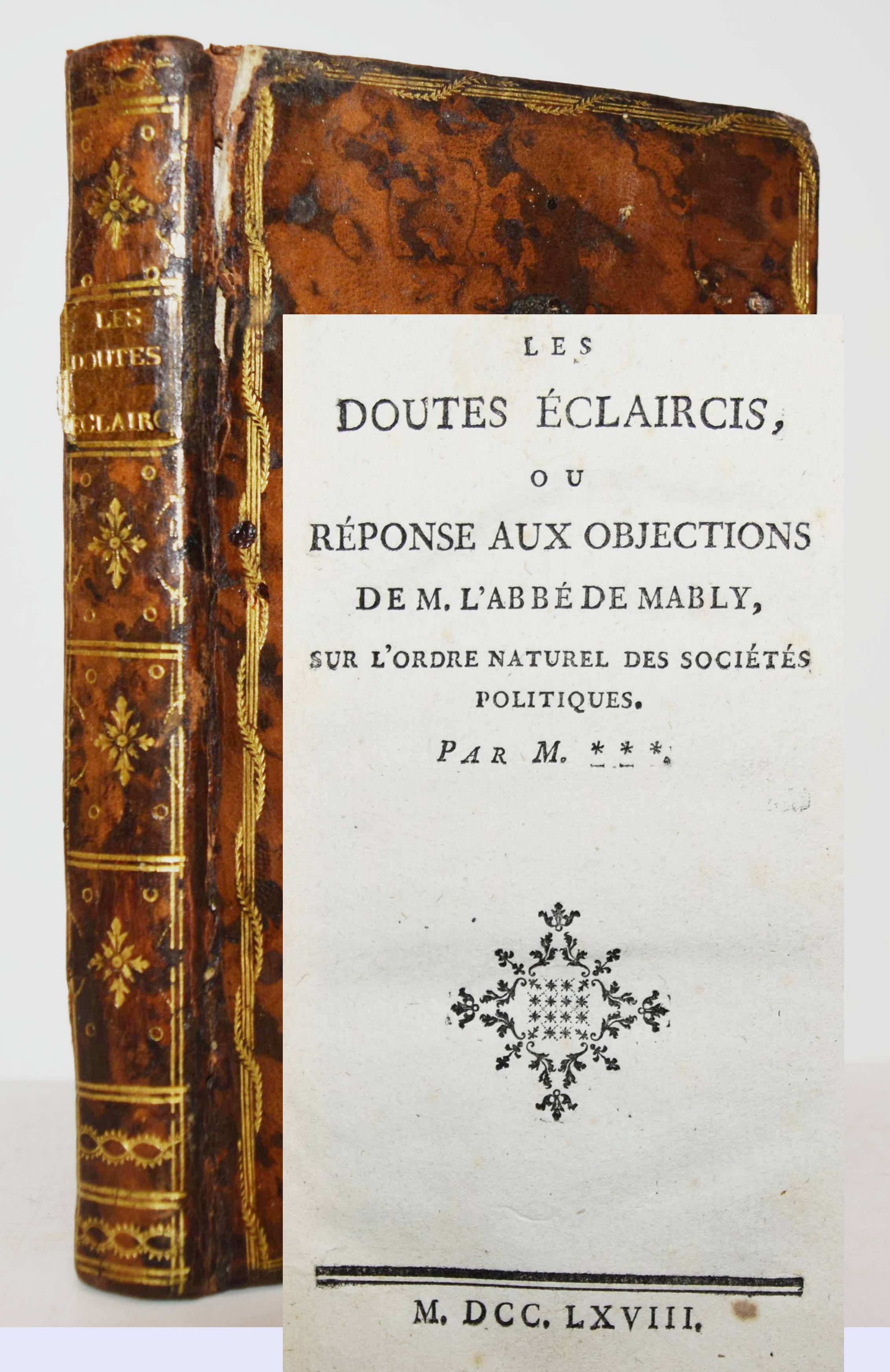
Quélen de Stuer de Caussade, Les doutes éclaircis

Quélen de Stuer de Caussade, Les doutes éclaircis

(Quélen de Stuer de Caussade, Paul-François de, duc de La Vauguyon). Les doutes éclaircis, ou réponses aux objections de l’abbé de Mably sur l’ordre naturel des sociétés politiques. Ohne Ort und Druck (Paris) 1768. Kl.-8° (17 x 10 cm.). 246, 23 S. Kalbslederband der Zeit mit dekorativer Rückenvergoldung und Deckel-Fileten.

Barbier I, 1111. Goldsmith 10397. Higgs 4363. Kress 6571. – Erste Ausgabe der Entgegnung auf Mablys Hauptwerk „Doutes proposés aux philosophes économistes…“ (Den Haag 1768). – „In 1768, Mably addressed to the economists, in the person of Mercier de la Rivière, his ‘Doutes proposés…’ This publication embodied an attack on landed property“ (Palgrave II, 655). – Die Physiokraten (die erste echte Denkschule der Ökonomie) argumentierten, dass wirtschaftliche Gesetze wie Naturgesetze (z. B. das Gesetz der Schwerkraft) absolut, unumstößlich und durch reine Vernunft erkennbar seien. Mably kritisierte dies als Abstraktion. Das Werk des Herzogs von La Vauguyon (1746-1828) verteidigt diesen epistemologischen Grundpfeiler der Physiokratie rigoros. Während Mably eine Eigentumsgemeinschaft und staatliche Regulierung zur Vermeidung von Armut forderte, untermauert La Vauguyon das physiokratische Dogma: Ein Staat muss sich wirtschaftlich völlig heraushalten (Laissez-faire). Der Monarch fungiert nicht als Gesetzgeber, sondern lediglich als „Vollstrecker“ der ökonomischen Naturgesetze. Das Werk zeigt idealtypisch den Übergang von der klassischen Staatsphilosophie hin zu einer modernen, rein ökonomisch und durch Eigentumsrechte legitimierten Staatsordnung. In Les Doutes éclaircis reduzierte La Vauguyon die Politik radikal auf die Vergrößerung des nationalen Wohlstands, dessen Quelle einzig in der Maximierung des landwirtschaftlichen Reinertrags (produit net) liege. Er hielt Mably entgegen, dass Eigentumsrechte und persönliche Freiheit untrennbar mit der Naturordnung verwoben seien. Ohne das Recht auf Eigentum gebe es weder Gerechtigkeit noch wirtschaftlichen Fortschritt. Den „legalen Despotismus“ verteidigte er geschickt: Der König sei kein Willkürherrscher, sondern lediglich der oberste Vollstrecker der durch die Vernunft offenkundigen, natürlichen Wirtschaftsgesetze. – Vorderes Gelenk im oberen Drittel mit Wurmschäden, gutes dekorativ gebundenes Exemplar.
First edition of the response to Mably’s magnum opus *Doutes proposés aux philosophes économistes…* (The Hague 1768). – “In 1768, Mably addressed his *Doutes proposés…* to the economists, represented by Mercier de la Rivière. This publication constituted an attack on landed property” (Palgrave II, 655). – The Physiocrats (the first genuine school of economic thought) argued that economic laws, like the laws of nature (e.g. the law of gravity), were absolute, irrefutable and discernible through pure reason. Mably criticised this as an abstraction. The Duke of La Vauguyon’s work rigorously defends this epistemological cornerstone of physiocracy. Whilst Mably called for a community of property and state regulation to prevent poverty, La Vauguyon reinforces the physiocratic dogma: the state must remain entirely uninvolved in economic affairs (laissez-faire). The monarch does not act as a legislator, but merely as an ‘enforcer’ of the natural laws of the economy. The work exemplifies the transition from classical political philosophy to a modern system of government that is purely economic in nature and legitimised by property rights. In *Les Doutes éclaircis*, La Vauguyon radically reduced politics to the enhancement of national prosperity, the source of which lay solely in the maximisation of net agricultural yield (*produit net*). He countered Mably’s argument by maintaining that property rights and personal freedom were inextricably interwoven with the natural order. Without the right to property, he argued, there could be neither justice nor economic progress. He skilfully defended ‘legal despotism’: the king was not an arbitrary ruler, but merely the supreme enforcer of the natural economic laws made evident by reason. – Front joint in the upper third shows worm damage; a fine, decoratively bound copy.

Unser Preis: EUR 320,-- 

1
2
3
4
5
6