


Sozialdokumentarische Fotografie
Die Liste enthält 4 Einträge. Suchergebnisse löschen und Gesamtbestand anzeigen.
| Abbildung |
Beschreibung Gesamte Buchaufnahme |
Preis EUR |
|
|---|---|---|---|
 |
Killip, Christopher. In flagrante. With an essay by John Berger & Sylvia Grant. London, Secker & Warburg (1988). 4° (31 x 21,5 cm.). 93 S. mit 50 Tafeln. Publishers cloth binding with illustrated dust jacket.
Auer 675. Parr/Badger II, 299. Roth, The Open Book 340 f. – First edition; inscribed by C. Killip „For Victor on 4 OB, Hasty Pudding Club, + Harvard All the best Chris“. – „In Flagrante is a singulary original work of art, both passionate and partisan. This is not an objective report. Killip tells his personal tale through these pictures, but he also allows his subjects’ collective story a clear voice of its own. The pictures in In Flagrante – primarily candid portraits and urban landscapes made in rich-toned black and white, predominantly shot with a 4x5 camera – were made in the northeast of England during the premiership of Margaret Thatscher… In Flagrante is a dark, pessimistic journey, perhaps even a secret odyssey, where rigorous documentary is suffused with a contemplative inwardness, a rare quality in modern photography“ (Parr/Badger). – „Renowned documentary photographer and former professor of visual and environmental studies Chris Killip died from lung cancer on Oct. 13. He was 74. Killip was a professor of photography in VES (now Art, Film, and Visual Studies) from 1991 to 2017, and the department chair from 1994 to 1998. For more than two decades, he had worked from the basement of the Carpenter Center, sharing his love of the art form with students and colleagues. … In 1988, Killip published his second and most famous book of photographs, “In Flagrante,” which captured the everyday fallout from deindustrialization and economic decline in northeastern England in the 1970s and 1980s. His arresting documentary style of photography captured the attention of critics and viewers alike, and Killip received the inaugural Henri Cartier-Bresson Award, now called le Prix HCP. … “His photographs embodied Henri Cartier-Bresson’s emphasis on the decisive moments, and Josef Koudelka’s eye for the surreal. He captured in arresting black-and-white photographs fleeting moments filled with powerful emotions,” said AFVS Professor Sharon Harper. “He was looking closely at people, labor, and the plight of the worker.“ The introductory photography course VES 40a, which he ran for many years, accommodated 100 students split into 10 sections. Even with so many spots, said Moss, the class often attracted two or three times as many students as it could accommodate. “Chris leaves quite a legacy of his documentary photography, which is known internationally, but also he has a legacy of students who were devoted to him and discovered photography through their studies with him,” added Harper“ (M. Aggarwal-Schifellite, Documentary photographer Chris Killip dies at 74, The Harvard Gazette, October 21, 2020). – A very fine copy of the rare hardback edition. Schlagwörter: England, Great Britain, Großbritannien, Signed books, Signierte Bücher, Sozialdokumentarische Fotografie, Widmungsexemplar |
1.400,-- |  |
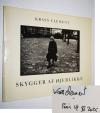 |
Clement, Krass. Skygger af Ojeblikke. Fotografier af Krass Clement. Kobenhavn, Chr. Erichsens Forlag 1978. Quer-Gr.-8° (22,5 x 26 cm.). 61 S., [1] Bl. mit 53 Duotone-Tafeln. Illustr. Orig.-Pappband.
Erste Ausgabe der seltenen ersten Veröffentlichung des bedeutenden dänischen Fotografen. Von Krass Clement signiert (″Paris 14 XI 2025“). – „Born in Copenhagen in 1946, Krass Clement is an autodidact photographer. Graduated as a film director from the Danish Film School in 1973, though continued with photography when it became evident that his future was not to be in film. A photographer since his early youth, Krass published his first book, Skygger af Øjeblikke (Shadows of Moments) in 1978. His photographic work emerges from two traditions: The Scandinavian melancholy on the one hand and the ‚flaneur‘ tradition from the Parisian school on the other. Starting out in black and white, Krass has persisted in developing and modernizing his artistic expression so that his production today also includes work in colour. … In his photography Krass is more concerned with capturing a state of mind than with situations. They are less documentary depictions than subjective moods somewhere between spectator and reality. Insisting on an artistic integrity, Krass Clement has created a strong personal body of work with the photo book as his favourite medium“ (krassclementdotcom). – Einband etwas gebräunt, sehr gutes Exemplar. Schlagwörter: Dänemark, Denmark, Signed books, Signierte Bücher, Sozialdokumentarische Fotografie |
850,-- | |
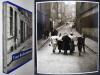 |
Chargesheimer (d. i. Karl-Heinz Hargesheimer). Unter Krahnenbäumen. Bilder aus einer Straße. Mit einem Text von Heinrich Böll. (Vintage reprint der 1958 im Greven Verlag Köln erschienenen Originalausgabe. 1998 neu herausgegeben, gestaltet und hergestellt von Eusebius Wirdeier). Bornheim, M. u. C. Schaden (1998). Gr.-8°. [58] Bl. mit zahlr. Abb. auf Tafeln u. 1 num. Orig.-Photographie (Silbergelatine, 23 x 20,7 cm.). Illustr. OPbd. mit illustr. OU. in illustr. Orig.-Pappschuber.
Vgl. Heidtmann 19603. Heiting/Wiegand 132 f. Koetzle 86 f. – Eines von 100 Exemplaren der Vorzugsausgabe mit num. (Nr. 39) Silbergelatine-Abzug. Das Foto zeigt eine Personengruppe in Karnevalskostümen von hinten aufgenommen und ist im Buch auf Blatt 8 abgebildet. – „Vielleicht wird nur in Straßen, wie diese eine ist, richtig gelebt.“ (Heinrich Böll). – Sehr gutes Exemplar. Schlagwörter: Köln, Nummerierte Bücher, Original-Photographie, Sozialdokumentarische Fotografie, Vorzugsausgaben |
500,-- | |
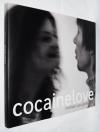 |
Graffenried, Michael v. Cocainelove. Wabern-Bern, Benteli 2005. Quer-Gr.-8°. 95 S. mit meist doppelblattgr. Duotone-Tafeln. OLn. mit illustr. OU.
Schweizer Fotobücher S. 485. – Erste Ausgabe. – „Während achtzehn Monaten hat Michael von Gaffenried das Drogenpaar Astrid und Peter mit seiner Kamera begleitet. Die Bilder zeigen einen schwierigen und unsicheren Alltag unter Drogen, zwischen Dealen, Gefängnis und Prostitution. Gleichzeitig verleihen die Bilder den beiden, welche die Gesellschaft als randständig ausgrenzt, ein Gesicht. Ein oft harter, manchmal zärtlicher, aber immer ehrlicher Blick“ (Klappentext). – Der Schweizer Bildjournalist M. v. Graffenried (geb. 1957) „hat nichts von der Direktheit oder der Unruhe Robert Franks und auch keinen neuen bahnbrechenden Stil, sondern schlicht ein gutes Auge (und damit eigentlich schon sehr viel). In einer Zeit, in der Unzufriedenheit bereits zu einer weit verbreiteten Haltung geworden ist, beherrscht er den schönen und zweckdienlichen Stil eines Reporters oder Straßenfotografen. Doch Form ist nicht der wesentliche Punkt; Inhalt ist alles. Er arbeitet schnell – mit einer 35-mm-Kamera – fotografiert sowohl in Farbe wie auch in Schwarzweiß (letzteres mit starken Kontrasten und einer gewissen Körnigkeit) und läuft angesichts der Widersprüche in der Welt zur Höchstform auf“ (V. Goldberg in Koetzle S. 176). – Tadellos. Schlagwörter: Drogen, Drogenabhängigkeit, Sozialdokumentarische Fotografie |
90,-- | |
|
Einträge 1–4 von 4
Zurück · Vor
|
|||
| Seite: 1 |